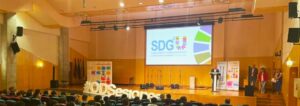
On Wednesday November 19, 2025, the American College of Greece (ACG) organized and hosted a comprehensive training seminar as part of the SDG4U Erasmus+ Project, titled “Engaging SDGs for Transformative Education and Enhanced Sustainability in Universities.” The event, addressed to both faculty and students, aimed to strengthen understanding and integration of the 17 United Nations Sustainable Development Goals (UNSDGs) within higher education.
The seminar was coordinated by ACG’s Center of Excellence in Sustainability (CoES), in collaboration with the SDG4U project partners: the National and Kapodistrian University of Athens (Project Coordinator), Panteion University of Social and Political Sciences, the University of Murcia, University College Cork, and UNIMED – Mediterranean Universities Union.
Two Dedicated Training Sessions
The program consisted of two targeted sessions—one for faculty and one for students—each designed to support deeper engagement with the SDGs through academic practice, research, and campus sustainability initiatives.
The program was structured into two dedicated sessions—one for faculty and one for students—with the overarching goal of actively engaging both groups and enhancing their awareness of the SDGs. Each session was tailored to encourage deeper involvement with the Sustainable Development Goals through academic practice, research initiatives, and sustainability actions on campus.
The Faculty session opened with an introduction of the 17 SDGs delivered by Dr. Stella Apostolaki, Assistant Professor of Environmental Science at Deree–ACG, Executive Director of CoES, and ACG’s Principal Investigator for the project, together with Dr. Paraskevi Papadopoulou, Professor of Biophysics and Cell Biology at Deree–ACG.
Following this, Professor Andreas Papandreou, Director of the Political Economy of Sustainable Development Lab at the National and Kapodistrian University of Athens and Co-Chair of UN SDSN Greece, presented the SDG4U project and its specialized Mapping Tool, an open-source platform designed to help universities align their curricula with SDGs. This innovative tool allows professors and students to assess and enhance the integration of sustainability in courses, offering features like interactive data visualization and comprehensive feedback mechanisms. By fostering collaboration and reflection, the tool inspires a culture of sustainability-driven education.
This session aimed to equip faculty with practical strategies for embedding SDGs and their sub-targets into new and existing curricula, as this is one of the project long-term objectives and the focus of the efforts put in place by Partners over the course of the past two-years
The Student Session began with an overview of the 17 SDGs by Dr. Apostolaki, after which students presented six “Campus as a Living Lab” projects, showcasing hands-on sustainability research and innovation:
- “AI Innovations and Environmental Impact in Biomedical and Environmental Sciences” – presented by Ms. Paniz Mokhtarpour (ACG), supervised by Dr. Papadopoulou
- “Total Ozone Monitoring on Campus” – presented by Ms. Zoi Trigkaki (ACG), supervised by Dr. Ioannis Christodoulakis
- “Mapping the Campus Biodiversity” – presented by Mr. Nikitas Vainores (ACG), supervised by Dr. Apostolaki and Dr. Anastasia Misseyanni
- “Wild Litter; Insect Hotels; Upcycling and Clothing Exchange” – presented by Dr. Ines Lopez Lopez, Catedrática de Universidad, Coordinator of Social Responsibility, University of Murcia (UMU)
The session concluded with an engaging SDGS Hackathon, where students worked in teams to tackle one of 26 sustainability challenges linked to the 17 UNSDGs, fostering creative problem-solving and interdisciplinary collaboration.
Contributing to sustainable development
Through interactive sessions, workshops, and a student hackathon, participants were actively engaged in learning more about the 17SDGs and challenged to think creatively on practical ways to integrate SDGs into university teaching and research.
While strengthening awareness on sustainable development, the seminar allowed faculty members and students to jointly reflect on the importance of contributing with innovative ideas to modern challenges, and institutions on how to embed sustainability as a core element of teaching, learning and research.
Universities are no longer viewers of changes but drivers of innovation and active players in promoting sustainability and generating more responsible citizens and youth.
Stay tuned about the next steps and follow us on Facebook, Instagram and X to be part of the sustainable change!